Authors are invited to make a submission to this journal. All submissions will be assessed by an editor to determine whether they meet the aims and scope of this journal. Those considered to be a good fit will be sent for peer review before determining whether they will be accepted or rejected.
Before making a submission, authors are responsible for obtaining permission to publish any material included with the submission, such as photos, documents and datasets. All authors identified on the submission must consent to be identified as an author. Where appropriate, research should be approved by an appropriate ethics committee in accordance with the legal requirements of the study's country.
An editor may desk reject a submission if it does not meet minimum standards of quality. Before submitting, please ensure that the study design and research argument are structured and articulated properly. The title should be concise and the abstract should be able to stand on its own. This will increase the likelihood of reviewers agreeing to review the paper. When you're satisfied that your submission meets this standard, please follow the checklist below to prepare your submission.
PREPARATION OF MANUSCRIPT
Manuscripts should be written in British or American English (but with consistency) on white A4 paper, portrait, double spaced throughout, leaving 2.54 cm wide margin on both sides and the content should appear in the following order: Title (in Title case), author(s) Name and address (es), abstract, keywords, introduction, materials and methods, results (with tables/figures embedded in the text), discussions, conclusions recommendations, acknowledgement, references, and list of authors’ ORCID numbers. Authors that do not have an Open Researcher and Contributor IDentifier (ORCID) can visit https://orcid.org/ to register in just three simple steps.
Articles should be prepared in MS word format in Times New Roman (12 font size) and should not exceed 12 pages. Any additional page attracts an extra charge.
Title of the Manuscript
The title must be written in the sentence case, reflect the content of the manuscript,and must not be more than 30 words. E.g.:“The Role of TLR-4 on the Mapkinases Signaling Pathways of Inflammatory Responses against Recombinant BCG Malaria Vaccine Candidate”
Authors
Authors should be listed with their surnames followed by the initials of other names. Affiliations should be stated after the authors’ names. The author for the correspondence should be indicated by an asterisk and his e-mail address should be provided. E. g
*1Tijjani, R. J., 2Yahaya, O. and 2Inabo, H. I.
1Departmemt of Microbiology, Kaduna State University, Kaduna, Nigeria.
2Departmemt of Microbiology, Ahmadu Bello University, Zaria, Nigeria.
*Corresponding Author: [email protected]; +2348065650770
Abstract
The abstract should be concise and informative, briefly containing the aims and how the work was done, the results obtained, and conclusions in less than 350 words.
Keywords – As the keywords are used for cross-referencing indexing, provide a maximum of 6 most relevant Keywords/terms found in the title or abstract. A Coma should separate the keywords.
Introduction
The introduction should be specific and relevant to the research, describing the problem statement, the state of the current work in the relevant field, the objectives and hypotheses being tested, and the contribution of your findings to the existing knowledge in the relevant field.
Materials and methods
This should be standard, concise, and relevant up-to-date details. State the reagents, types of equipment, software, etc used in the research. Provide detailed information on the various stages/steps of the methodology/experimental design and statistical methods used in data analysis.
Results
Results should be well presented with tables and figures orderly arranged. Avoid duplication of information in the table, figures, or text.
Discussion
The discussion should be concise and not a repetition of results. Focus on the work presented, scientific interpretation of results, and their relationships with other relevant recently published works.
Conclusions
Point out the main result(s) obtained that differ from previous recent works and thus deserve publication.
References
UJMR uses APA system of referencing. References cited in the text must be recent and must be listed under the reference list.
List of Authors’ ORCID numbers
This should be placed below the list of references. E.g
Author A ORCID: -----------------------------
Author B ORCID: -----------------------------
Author C ORCID: -----------------------------
SUBMISSION AND EDITORIAL PROCESS
A. Submission via Website
To submit a manuscript, Authors are required to log in (pre-existing users) or register (for new users) their account on the journal website. Using the journal online submission platform, three (3) separate attachments are required to be uploaded at the onset of the submissions:
1) Attachment 1: a document containing the Manuscript title, authors' names, affiliations and other information (ORCID IDs and the corresponding authors' Email).
(2) Attachment 2: Main manuscript (without the Authors' names and their affiliations/information).
(3) Attachment 3: scanned copy of evidence of payment (of the manuscript processing fee of 5,000 naira). Manuscripts not accompanied by processing fees will not be processed.
DOUBLE-BLIND PEER REVIEW PROCESS
The UMYU Journal of Microbiology Research (UJMR) employs a double-blind peer review system to ensure fairness, transparency, and high academic standards in the evaluation of all submitted manuscripts. In this system, both reviewers and authors remain anonymous throughout the review process.
Review Workflow
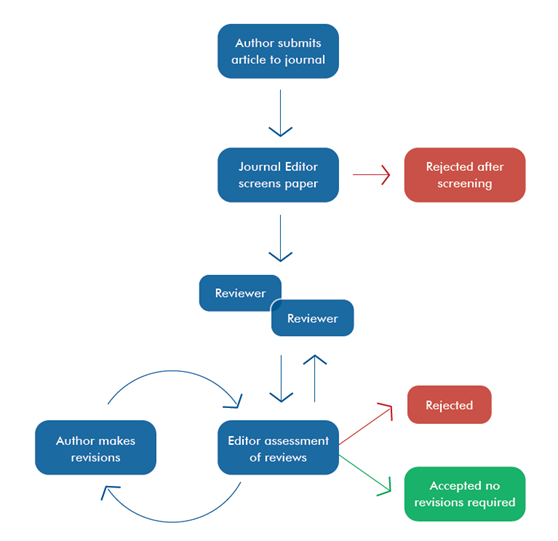
Upon submission, every manuscript is screened by the Editorial Office to confirm its compliance with journal scope, formatting requirements, ethical standards, and originality (including plagiarism checks).
Manuscripts that pass initial screening are assigned to a minimum of two independent expert reviewers with relevant subject expertise. Reviewers are selected based on their academic qualifications, research experience, and absence of conflicts of interest.
Reviewers provide constructive comments and a clear recommendation (accept, revise, or reject).
The Editor-in-Chief or Handling Editor makes the final decision based on reviewers’ reports, journal standards, and the manuscript’s scholarly contribution. Authors are notified promptly of decisions and provided with anonymized reviewer comments.
Authors of manuscripts requiring revision must address reviewers’ comments point-by-point and submit a revised version within the stipulated timeframe. Revised manuscripts may undergo further review.
Once accepted, the manuscript proceeds to copy-editing, typesetting, and proofing stages before publication online and in print.
Reviewer Responsibilities
Editorial Integrity and Fairness
UJMR adheres to the COPE (Committee on Publication Ethics) standards and DOAJ’s Best Practice Guidelines. All manuscripts are evaluated solely on scientific merit, without discrimination based on authors’ nationality, institutional affiliation, gender, or personal characteristics. No submission or publication decision is influenced by commercial or institutional interests.
Transparency
The journal publicly discloses its peer-review process and ensures that:
ARTICLE PROCESSING FEES
UJMR is an Open-Access journal and charges the following fees:
· Manuscript Processing Fee: ₦5,000 (USD 25 for international authors), payable on submission.
· Publication Fee: ₦15,000 (USD 25 for international authors), payable upon acceptance.
Payments must be made only to:
Account Name: UMYU Journal of Microbiology Research (UJMR)
Account Number: 2099599544
Bank: United Bank for Africa (UBA), IBB Way Branch, Katsina, Nigeria.
Refund Policy:
All payments are non-refundable once processing or publication has commenced.
PUBLICATION FREQUENCY:
The journal is biannual, published in June and December. All papers accepted for publication in UJMR will appear simultaneously in the print journal and online. The editors, therefore welcome submissions of original manuscripts that have not been published or considered elsewhere for publication.
ETHICS OF PUBLISHING IN UJMR
Plagiarism
Authors should note that plagiarism and breach in research ethics are not tolerated by this Journal. Hence, all manuscripts submitted to UJMR are subjected to plagiarism checks before accepting for publication. Authors must not submit papers that are under review/consideration in other journals. Authors must fully acknowledge all sources of their information, such as methodology, figures etc. Authors are responsible and liable to the content of their manuscripts.
Authorship
Authorship is restricted to persons who contributed to the paper (eg. design and/or analysis and interpretation of the data/or drafting of the paper). All authors must review and approve the contents of the final version of the manuscript before submitting it for publication.
Conflict of Interest
The authors must declare a conflict of interest (if any) while submitting the final version of the manuscript for publication.
Acknowledgement
Authors are required to state contributions that do not justify authorship but need to be acknowledged/disclosed; source of funding, technical or material support, etc.
Copyright Policy
By submitting a manuscript for publication in UMYU Journal of Microbiology Research (UJMR), authors have agreed on the copyright policy of UJMR which operates based on open access copyright policy (CCBY-NC 4.0 license) under which any person can copy, reuse or redistribute the published articles for any non-commercial purpose(s) provided that the author and the source of the article are properly cited.
Manuscript Withdrawal Policy of UMYU Journal of Microbiology Research (UJMR)
UMYU Journal of Microbiology Research (UJMR), reserves the right to retract any published article when there is suspected plagiarism or any scientific misconduct. The author can request for the withdrawal of manuscripts before or after publishing via a formal written request addressed to the Editor-in-Chief of UJMR with full justifications. Approvals for the withdrawal of manuscripts depend on the decision of the Editor-in-Chief and the editorial board of UJMR. There will be no refunds of article processing and /or Publication charges paid to UJMR if the processed/published manuscript is withdrawn.
SUMMARY OF UJMR EDITORIAL PROCESS
All submissions must meet the following requirements.
The names and email addresses entered in this journal site will be used exclusively for the stated purposes of this journal and will not be made available for any other purpose or to any other party.